

 Download PDF (46.88 KB)
Dr. Jeff Williams, CTO, OxiScience LLC
Background: The epidemic of African Swine Fever (ASF) now sweeping through China and other Asian countries and spreading steadily across Europe is caused by a highly contagious virus. Infected pigs die; there is no treatment possible, and there is no vaccine toprevent infection in animals not yet exposed. ASFpersists in the environment, in pig carcasses and meat, and is readily and quickly carried beyond farms that experience outbreaks. More effective disinfection measures are needed in the face of a looming disaster.This is already the worst animal diseaseoutbreak in the history of the world:(https://www.vox.com/2019/6/6/18655460/china-african-swine-fever-pig-ebola)
The magnitude of the problem: ASF first appeared in China in 2018 but was detected in wild boars in Eastern Europe several yearsago. ASF does not affect humans or animals other than pigs. While no direct health risks are posed to people or their ruminant livestock, the impact of the disease on domestic pork supplies and the knock-on effects on social stability are huge. Pork accounts for sixty % of Chinese meat consumption, half of the worldwide pork market. Prices are skyrocketing as about half of the 300 million pigs in China have either died or been culled since the outbreak began. In 2019 ASF spread from China to other Asian nations, including So and N Korea, Vietnam, Laos, Philippines& Indonesia. This year the virus moved across Europe to Belgium and France;so far only wild boars are infected but spread into domestic pigshas already happened in the Eastern region. Pork prices in China are up 70%, causing escalating imports from ASF-free regions, like the US, to try to meet the animal protein needs of the population. A pork-driven social breakdownis feared if the outbreak is not contained.
Control measures and needs: ASF belongs to a peculiarclass of viruses. Research on ASFis difficult and costly because of the risks of contagion and transmission. Countries such as the US with large pig populations are on high alert to prevent importation of virus in contaminated pork products or waste streamsfrom Asia and EU. No disinfectants have ever been tested and approved by the US-EPA for use versus ASF. A national EPA Emergency Measure has been issuedallowing for the use of concentrated chlorine bleach (3000 mg/L) for environmental decontamination if ASF arrives in the US. No other disinfection measures are allowed under this measure.
Concentrated Cl bleach is being used in China, both for environmental surfaces and animals, However, this solution is extremely corrosive, hazardous to personnel, damaging to farm housing and equipment, and moreover, it has only a very short-acting effect, so it offers inadequate protection in the face of such a contagious virus. What is needed is a safer formulation with the power of bleach that can persist on treated surfaces or skin to maintain effective virus killing for a long time. OxiScience technology meets that need.
The OxiScience Solution: The Stabilized Oxidant disinfectant (SO) formulation made by OxiScience LLC, protected by US Patent # 10,028,482 (2018), has been tested under rigorous
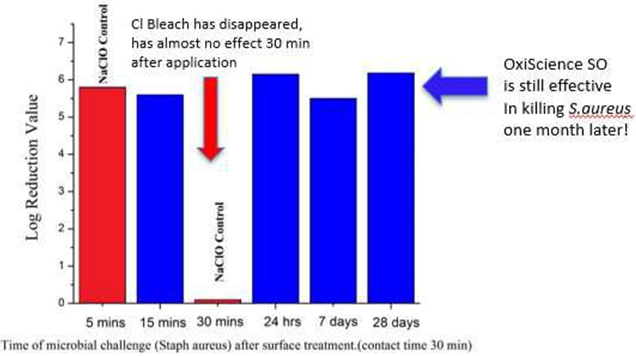
conditions at Case Western Reserve University, a major US research institution. It was shown to be just as effective in the short run as concentrated chlorine bleach in killing germs that are even more resistant than ASF (Figure 1). But in striking contrast to bleach, the effectiveness of OxiScience SO persisted at high levels not just for days after treatment of surfaces but for weeks. Treated surfaces were still capable of killing antibiotic-resistant Staphylococcus aureus one month after the original application. Chlorine bleach-treated surfaces had no useful effect on these bacteria after 30 minutes, and almost none remained 15 minutes after the application.
Figure 1: OxiScience SO disinfection compared to Chlorine bleach on treated surfaces challenged with Staph aureus bacteria
OxiScience SO:
- Is used at 1/6thof the concentration recommended level for Cl-bleach
- Is much safer for personnel, the environment and animals
- Poses no threat of resistance development
- Is much less corrosive than chlorine bleach
- Contains an EPA-registered biocide in an entirely novel formulation
- Can be made up at high volume manufacturing scale from a proprietary concentrated mixin water
- Is cost-competitive in use with bleach
When these advantages are added to the value of persistent high-level efficacy over days to weeks after single applications, the need for Oxi SO to be put into widespread use in ASF and other contagious disease control measures is obvious. OxiScience can make samples of SO available immediately for testing in China versusASF virus isolates from thecurrent outbreak in order to prove effectiveness and safety.
OxiScience can make samples of SO available immediately for testing in China versusASF virus isolates from thecurrent outbreak in order to prove effectiveness and safety.