

 Download PDF (495.25 KB)
CORONACIDE™ WHITE PAPER: February 12, 2020
Persistent high level protection of environmental surfaces
against germ contamination: CoronaCide™, an innovation in
disinfection technology to combat the spread of pandemic infections
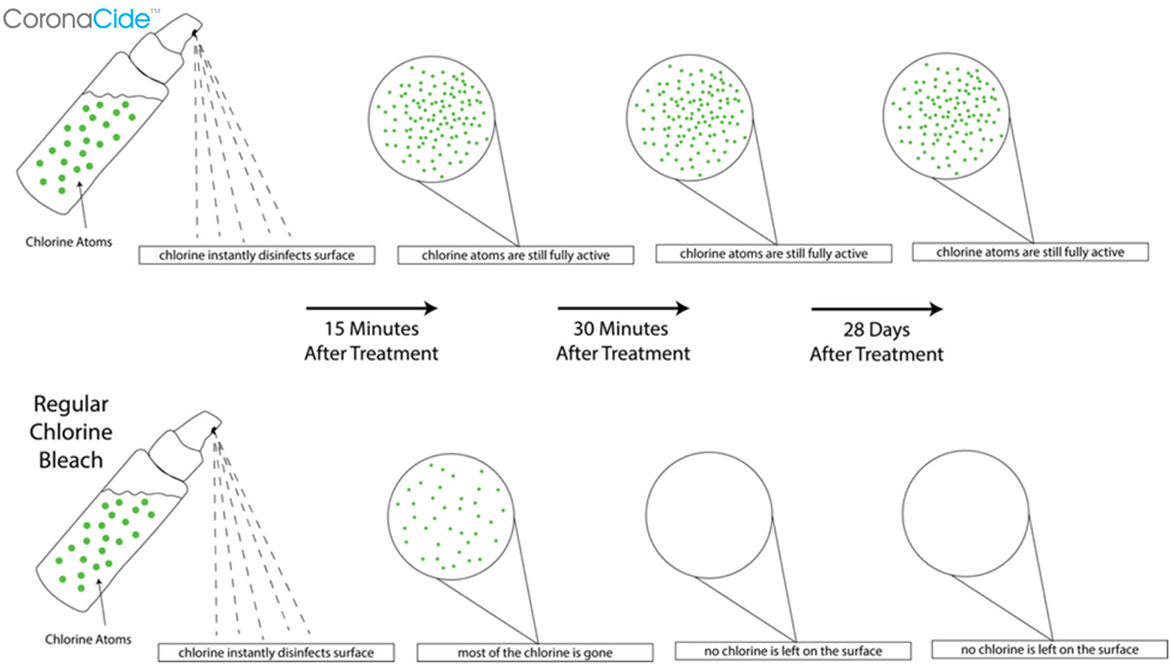
Ongoing worldwide efforts at controlling environmental contamination with the most recent and dangerous emerging infectious agent (2019-nCov [now officially COVID-19] )1 are undermined by the use of inadequate disinfection procedures. This is due to widespread dependence on conventional antimicrobial formulations that offer only short term protection of surfaces that become contaminated with corona viruses. There is an urgent need to improve surface protection measures by adopting use of newly available formulations that, for the first time, deposit long-lasting and powerful antimicrobial activity on treated surfaces, both hard and soft. The CoronaCide™ team developed these unique solutions (US Patent #10,028,482 [2018]) to take full advantage of the superior germ-killing effectiveness of chlorine (Cl) atoms. The technology does this by binding active Cl into biodegradable coatings that endure on disinfected surfaces. Compelling evidence from rigorous experiments described in the Supplemental Information (Below, pages 3-9) makes a strong case for the practicality and persistent efficacy of CoronaCide™-treated surfaces. The formulations (CoronaCide™) add a new and unprecedented means of attack on the environmental spread of infectious diseases for the 21st Century.
Evidence from previous coronavirus epidemics caused by human-adapted Cov variants (SARS, MERS) shows that infectious viral particles can persist on surfaces exposed to infected patients for up to 9 days2, 3, 4. Survival for 4-5 days is common2. There is every reason to expect 2019- nCov Wuhan to be at least equally persistent2. Current disinfectants, of which the most powerful and popular is aqueous chlorine (Cl) as hypochlorite bleach, are known to be effective at inactivating coronaviruses rapidly, and to a high level in the laboratory2,5. But once applied to targeted surfaces they disappear within minutes by evaporation (e.g., bleach, ethanol, isopropanol) or chemical degradation on exposure to air (e.g., chlorine dioxide).
The 2019-nCov variant is extremely contagious1, and infectious viruses in expired air and other bodily excretions of patients6 will ensure rapid repopulation of environmental surfaces, where they will normally endure. Transmission by touching deposits of the virus and transferring these to the face is one of the most common means of acquiring infection7,8. If excreted viruses in droplets land on CoronaCide™ -treated surfaces that continue to display germ-killing amounts of Cl for weeks after a single application there is a high likelihood of virus inactivation to a useful degree in preventing contagion.
Data from experiments involving challenge of treated surfaces with infectious germs of all kinds— bacteria, viruses, yeasts, fungi, spores—up to two months after one disinfecting treatment demonstrate that levels of kill are maintained at a high level across the board (Supplemental Information). Treated surfaces are safe to touch, and CoronaCide™ formulations are water-based, and easy to apply with traditional equipment and methods. The principal active component in the formulation is an EPA-registered biocidal agent.
Many factors will influence the duration and extent of the killing efficacy in the real world, including temperature, humidity, organic deposits (such as sputum, saliva, feces), sunlight exposure, etc. But these scientific data collectively provide a solid basis for incorporating CoronaCide™ persistent disinfectant protection into current infection control efforts not only for 2019 -nCov, but for all the germs, old or emerging, that continue to plague at-risk populations everywhere, both human and animal (e.g., influenza, COVID-19, ASF, norovirus).
References:
- World Health Organization. Novel Coronavirus (2019-nCov). Situation report. WHO
- Kampf, G et al., Persistence of coronaviruses on inanimate surfaces and its inactivatoin with biocidal agents. J Hospital Infection (2020), DOI:10.1016/j.jhin.2020.01.22
- Van Doremalen, N et al., Stability of MERS-CoV under different environmental conditions. Euro.Surveillance (2013),
- Casanova, LM, et , Effects of air temperature and relative humidity on coronal virus survival on surfaces. (2010), 76, 2712.
- Rabenau, HF, et al. Efficacy of various disinfectants against SARS coronavirus. J.Hospital Infection (2005), 61,
- https://www.scmp.com/news/china/politics/article/3048611/coronavirus-scientists-identify-possible-new-mode-transmission
- Kwok, YL, et al., Face touching: a frequent habit that has implications for hand hygiene. Amer. J Infection Control (2015), 43, 112
- Warnes, SL et al., Human coronavirus 229E remains infectious on common touch surface materials. mBIO (2015),6, e01697
Supplemental Information:
Primary experimental evidence of
efficacy of CoronaCide™ technology
Primary experimental evidence of efficacy of CoronaCide™ technology
Authors: Jennifer Cadnum, MS and Curtis Donskey, MD*
Department of Medicine, Veterans Administration Hospital and Case Western University Medical School, Cleveland, Ohio
The purpose of this study was to establish the antimicrobial efficacy and the persistence of efficacy of CoronaCide™-treated solid surfaces in comparison to the industry gold standard of 10% sodium hypochlorite (chlorine bleach @ 6000 ppm).
CoronaCide™ formulation and Cl bleach solutions were sprayed onto Formica solid surface areas and allowed to air dry. At intervals after the coatings were dry suspensions of Multiple Antibiotic Resistant Staph aureus (MRSA) bacteria were applied as challenge inocula. Untreated Formica was similarly challenged so as to measure the recovery of MRSA bacteria that could be expected from a normal (unmodified) Formica surface. After contact for 30 minutes the degree of killing of the microbes was measured by recovering them from test surfaces and comparing the recovered bacteria colonies to the numbers recovered from control (uncoated) surfaces and from surfaces exposed to chlorine bleach.
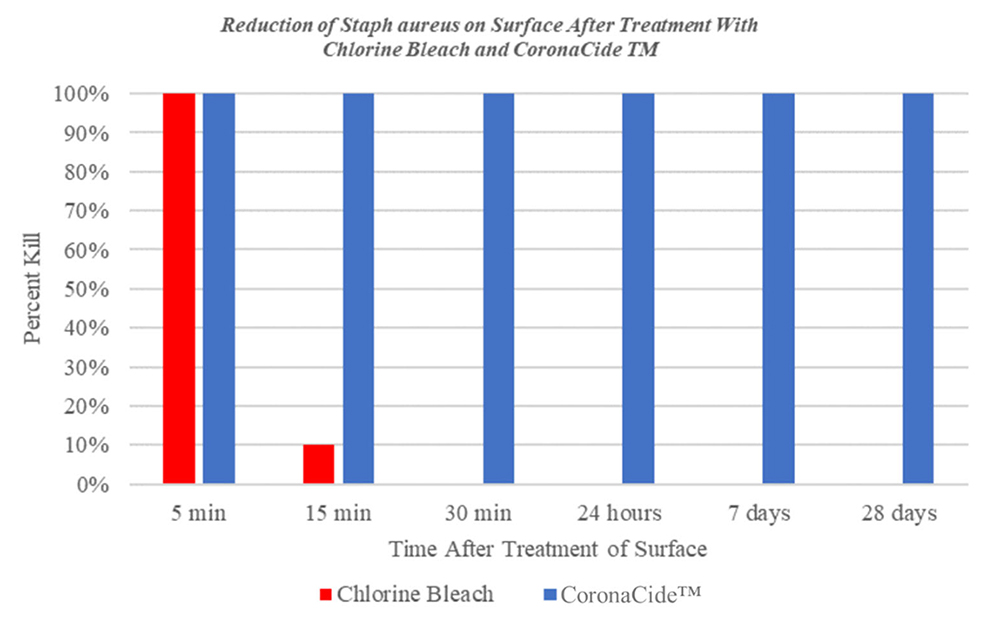
CoronaCide™ treatment of Formica surfaces provided high levels of germ kill not only at the earliest challenge time points, but also at all the other challenge time points through the following 28 days (the longest time tested in the study) (See figure below). Surfaces treated with 10% hypochlorite bleach showed high efficacy at the earliest time points of challenge, but the effectiveness then rapidly declined so that by 30 minutes post-drying it had disappeared completely. The stabilization of the active Cl atoms in the CoronaCide™ clearly allowed for high level persistence of efficacy on the coated surfaces for 28 days without noticeable decline.
*Dr. Donskey is a recognized authority on coronaviruses (e,g, Otter, JA, Donskey, C, Yezli,S, Douthwaite, S, Goldenberg, SD and Weber, DJ: Transmission of SARS and MERS Coronaviruses and influenza virus in healthcare settings; the possible role of dry surface contamination. J. Hospital Infection Control, 2016, vol 92, 235-250
Antimicrobial properties of nonwoven textiles treated with CoronaCide™ formulations.
Author: Jose Santiago, MS (Microbiology), Director
Pacific Northwest Microbiology Services, Bellevue, WA
The purpose of this experiment was to measure the antimicrobial efficacy of nonwoven fabric samples that had been treated with different amounts of CoronaCide™ solution, dried, and shown to contain a range of active chlorine concentrations.
Antibacterial tests were conducted according to a modification of AATCC Test Method 100-1999. All tests were performed in a Biosafety Level 2 hood. In this study, Staphylococcus aureus (S. aureus, ATCC 6538) and Escherichia coli (E. coli, ATCC 15597) were used as typical examples of Gram-positive and Gram-negative bacteria, respectively. Candida albicans (C. albicans 10231) was employed to challenge the antifungal activities of the samples. E. coli bacteriophage MS2 strain 15597-B1 virus was used to represent viral species. Bacillus subtilis spores obtained from North American Science Associates (Northwood, Ohio; lot no. N24609) were used to challenge the sporicidal properties of the treated fabrics.
All the coated fabrics had chlorine contents that showed potent biocidal efficacy against a wide range of microorganisms. Shown in Table 1 are results for Gram-negative bacteria, Gram-positive bacteria, fungi, viruses and spores. Higher active chlorine contents in the finished textile samples led to more potent biocidal efficacies. At 4960 ppm chlorine content, the treated fabrics provided a total kill of 108–109 CFU/mL for S. aureus, E. coli, and C. albicans in only 3 min or less. MS2 virus appeared to be more resistant than the bacterial and fungal species tested: at the same chlorine content, it took 10 min for the fabrics to offer a total kill of 106–107 PFU/mL for the virus.
Table 1. Antibacterial activities of treated fabrics with various active chlorine contents resulting from an aqueous finishing bath exposure to CoronaCide™
| Active chlorine content | Minimum contact time for a total kill (min) | ||||
| (ppm) | S. aureus | E. coli | C. albicans | MS2 virus | Spore |
| 558 | 30 | 30 | 60 | 120 | N/A |
| 1080 | 15 | 15 | 30 | 60 | 480 |
| 2952 | 2 | 2 | 5 | 15 | 120 |
| 4960 | 1 | 1 | 3 | 10 | 10 |
Antimicrobial properties of hard surface (Formica) coupons
treated with CoronaCide™ formulations.
Author: Jose Santiago, MS (Microbiology), Director
Pacific Northwest Microbiology Services, Bellevue, WA
The purpose of these tests was to determine the antimicrobial efficacy and surface persistence of active chlorine resulting from treatment of hard surface coupons (Formica) with two different CoronaCide™ formulations applied as a spray. Formica swatch samples were procured from Home Depot. Formica coupons were used with either smooth or textured surfaces. Coupons were sprayed and air dried at room temperature, and then stored for 15min, 24h, 7 days and 2 months under normal laboratory conditions in the dark, before being challenged with microbial suspensions to determine efficacy. The antimicrobial testing was performed according to a modified Japanese Standards Association protocol, ISO 22196:2007/JIS Z 2801:2000 titled “Antimicrobial products- Test for antimicrobial activity and efficacy.”
Procedure: Each test piece was cut into squares 50mm ± 2mm each side. They were sterilized with dry heat to minimize warping by wrapping in aluminum foil and placing them in an oven at 180°C for 30 minutes. Test coupons were then sprayed with one of the CoronaCide™ solutions and allowed to air dry. Unsprayed samples served as controls. Some coupons were wiped with a sterile cloth after air drying to see if the coating was readily removed or not.
Test Inoculum Preparation: One day prior to testing, a Staphylococcus aureus overnight culture was prepared by using a sterile 4mm inoculating loop to transfer one loop-full of bacteria from a TSA plate onto a Nutrient Agar (NA) slant. After overnight culture at 34-36°C, a loop-full of bacteria was transferred into 10 mL of 1:500 nutrient broth by dragging a sterile 4mm inoculating loop in a straight line up the length of the slant. If it was necessary, 1:500 Nutrient Broth (NB) was used to arrive at a final challenge concentration of 6×10⁵ cfu/100µL.
Antimicrobial Testing Procedure: Parafilm film was cut into squares with 40mm ± 2mm each side. Prior to testing, each piece of parafilm was cleaned with ethanol and allowed to air-dry. Aseptically the carrier test pieces were transferred into sterile petri-plates. Each test piece was inoculated with 100µL of the challenge inoculum. Test coupons were covered with a piece of clean parafilm and gently pressed so that the challenge inoculum spread over the parafilm area making sure that inoculum did not spill over the edge. Petri-plates were allowed to sit in the bio- safety cabinet at room temperature for 30 minutes. After a 30 minute contact time had elapsed, sterile tweezers were used to carefully transfer each of the treated and untreated test pieces into individual sterile Whirl-Paks containing 10 mL of SCDLP broth.
Test coupons were massaged in neutralizing solution for at least thirty seconds. 10-fold serial dilutions of the SCDLP broth in DPBS were prepared. The SCDLP broth and dilutions were placed onto Plate Count Agar (PCA) using the spread-plate method. Plates were incubated at 34-36°C for 48 hours. After the incubation period, the plates were used to establish colony plate counts so as to calculate the corresponding Log Reduction values (LRV).
Results: As shown in Table 2, the coated Formica surfaces showed persistence of high levels of antimicrobial efficacy even after two months. At two months, the coupon surfaces, both smooth and textured provided more than 3 LRV and in some cases up to >7 LRV of challenge test organisms. Wiping air dried coupons did not readily remove the antimicrobial coating.
Table 2, Antimicrobial efficacy and persistence on Formica coupons coated with CoronaCide™ formulations and challenged with S. aureus
| Sample Description Disinfecting fluid |
Post | Dry | Substrate | CFU/100µL | LRV |
| #1 | 15 min | air dried | Textured, black | 2.00E+00 | 7.17 |
| #1 | 15 min | Wiped | Smooth, white | 1.00E+00 | 7.48 |
| #2 | 15 min | Air-dry | Textured, black | 1.00E+00 | 7.48 |
| #2 | 15 min | Air-dry | Smooth, white | 8.40E+01 | 5.55 |
| #2 | 15 min | Wiped | Textured, black | 0.00E+00 | 7.48 |
| # 1 | 24 h | Air-dry | Textured, black | 1.50E+01 | 6.3 |
| #1 | 24 h | Air-dry | Smooth, white | 1.00E+00 | 7.48 |
| #2 | 24 h | Air-dry | Textured, black | 4.00E+00 | 6.88 |
| #2 | 24 h | Air-dry | Smooth, white | 5.00E+00 | 6.78 |
| #1 | 7 d | Air-dry | Smooth, white | 1.35E+02 | 5.55 |
| #2 | 2 m | Air-dry | Smooth, tan | 1.20E+04 | 3.34 |
| #2 | 2 m | Wiped | Textured, tan | 6.00E+00 | 6.64 |
| Unsprayed Control | Air-dry | Textured, black | 3.40E+08 | – | |
| Unsprayed Control | Air-dry | Smooth, tan | 3.50E+08 | – | |
| Sterility Control | Textured, black | 0.00E+00 | – |
Wet bath treatment of nonwoven textile substrate as a means of establishing
high level active Cl coatings using CoronaCide™
Author: Jose Santiago, MS (Microbiology), Director
Pacific Northwest Microbiology Services, Bellevue, WA
The purpose of these experiments was to measure the amount of active chlorine that could be bound to nonwoven textile swatches by using iodometric titration of the oxidative Cl content.
Nonwoven polypropylene textile samples prepared by wet bath exposure at room temperature to CoronaCide™ were tested after air drying to measure the active chlorine contents by iodometric titration as an indicator of the successful application of the coating. Coated fabric swatches 0.5~1 g of were cut into fine fragments, and treated with a solution of one g of KI in 100 mL of deionized water (the solution contained 0.05% (v/v) of TX-100) at room temperature under constant stirring for 1 hour. The amount of Iodine (I2) formed was titrated with standardized sodium thiosulfate aqueous solution. The uncoated fabrics were tested under the same conditions to serve as controls. The available active chlorine content on the fabrics was calculated according to equation (1):

where VS, V0, CNa2S2O3 and WS were the volumes (mL) of sodium thiosulfate solutions consumed in the titration of the coated and uncoated samples, the concentration (mol/L) of the standardized sodium thiosulfate solution, and the weight of the chlorinated sample (mg), respectively.
By adjusting the CoronaCide™ concentrations used the wet bath, a series of polypropylene fabric swatches was obtained with active chlorine contents of 558, 1080, 2952 and 4960 ppm, respectively. The results demonstrated the acquisition of sufficient chlorine to confer high level antimicrobial functionality on the fabrics by use of a finishing method (wet bath/nip/air dry) common to the industry.
Safety of MACS- treated soft surfaces for skin and respiratory exposure.
Author: Jeffrey F. Williams
The active ingredients in the MACS formulation are safe for prolonged skin contact, and do not cause irritation or sensitization. The major functional active is a registered US EPA biocidal compound. The polymeric agents used to enhance binding to fibers are US FDA-GRAS listed (Generally Regarded As Safe) and are safe enough to be incorporated into many consumer cosmetic and food products.
An extensive review of the contact and environmental safety of the MACS active compound class is included in EPA Document-HQ-OPP-2013-0220-0008. A closely related compound in the class (more potent than the MACS components) is widely used as a sanitizer in millions of recreational hot tubs and spas in the US, with no indication of toxicity or allergic sensitization after decades of exposure of human subjects in this intimate way.
When measured using an Interscan 4000 Portable Gas Meter equipped with a Cl-sensitive electrode, MACS-treated masks released active Cl atoms at a barely detectable rate of <0.003 micrograms of chlorine per minute. This results in an exposure that is insignificant in comparison to the US OSHA occupationally-allowed rate over a working day of 0.5 ppm in 240 L of inspired air (https://www.osha.gov/dts/sltc/methods/inorganic/id101/id101.pdf).