

 Download PDF (422.08 KB)
Introduction: OxiScience LLC scientists have developed unique, patented water-based formulations of Cl-binding heterocyclic compounds for use on soft surfaces (US patents #10,028,482, US#10, 131,731, 2018*, and coinventor status on US Patent # 9, 700, 040). Certain formulations integrate oxidative N-halamine structures into novel permanent cross-linked polymers. These coatings not only confer potent antimicrobial and odor control properties on textiles, but are durable enough to allow for routine, laundry-based refreshing of these functions. The result is an unprecedented display on commonplace textiles of the ability to rapidly kill germs of all kinds that come into contact with the oxidatively charged surfaces, whether woven, nonwoven or knitted.
The Technology: Suitable textile compositions can include cotton and rayon goods, and blends with synthetic fiber components. The coating process is compatible with currently applied range technology for woven and nonwoven textile production, and for batch treatment of knitted goods. It requires conventional dip/nip/cure processes, allowing for wet bath exposures followed by a mild high temperature cure before the products can be charged with oxidative Cl. Therafter the coatings will remain on the fibers for the rest of the life of the textile, and can be recharged >50 times. Active chlorine charging of the coating can be accomplished through in-plant final rinsing, and then by repeated user-based
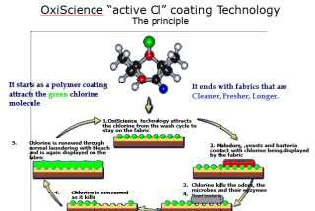
laundering (See figure 1).
The fully charged coating accomplishes the following:
- It kills bacteria, viruses, and yeasts on contact, quickly, powerfully, safely, in a way that poses no hazard at all to skin and mucous membranes.
- It attacks and degrades a wide range of malodor compounds, including sulfur-containing microbial waste products. The film does not just fix or bind odors, it destroys these molecular constructs, and reduces them to chemical rubble. Rubble that has no smell.
- It stops the enzymes released by bacteria and yeasts from digesting nutrients in human sweat, sebum, sloughed-skin cells, mucus, etc., so that they cannot generate bad-smelling waste products.
The rechargeable OxiScience coatings have no downside effects on the look and feel of knit or woven fabrics, natural or synthetic fibers or blends, or on their wear-life duration, or physical attributes (fiber tensile strength, etc.). The active Cl recharge process is achievable with routine laundry exposure, and once in place this bound chlorine has no objectionable smell. Fully charged textile swatches have been thoroughly tested for safety using the standard EPA-required, third party contracted, animal exposure protocols, including for sensitization.
The principals of OxiScience have been involved in this area of textile chemistry for 20+ years, and brought one early version to market in the US (HaloShield, co-branded with Clorox Co.) specifically targeted to odor control. There are now several new generation polymer coatings available and controlled by OxiScience IP or acquired by exclusive licensed right. The company’s executives have published extensively in the peer-reviwed scientific literature in this technology field. Each of the OxiScience coatings provides for very rapid rates of kill of all germ types on contact , usually to the extent of 99.9 to 99.9999% of challenge microbes, within minutes or sometimes even seconds, depending on the organisms involved.
The Opportunity:
While anecdotal accounts of experiences with Cl-coated garments in use indicate significant benefits arising in the resolution of skin conditions, like Athlete’s foot, and acne, the major opportunity lies in the area of infection control. Recent years have seen the accumulation of compelling evidence that healthcare textiles contaminated with germs, on garments of personnel, on bed linens, curtains, can be responsible for serious outbreaks of infectious disease. Long suspected but only more recently proven, these episodes of disease spread are the result of persistent survival of all kinds of microbes on textile surfaces.
Persistence of many causes of hospital acquired infections on conventional textile surfaces is now known to be more common and last much longer than anyone suspected. Integration of antimicrobial properties has been attempted with a variety of chemistries but none shows the power, speed and durability of OxiScience coatings. The poor performance of current market offerings leaves a significant opportunity available for effective innovation in the healthcare sector, and one that promises to make serious impact on contemporary infection control measures.
Contributing to these potential improvements in overall institutional infection control with a cost-effective, scalable, readily implemented novel technology with proven credentials, is a worthy goal, and one that merits widespread adoption of the company’s innovations.
Additional advantages of the technology, resulting from its powerful odor control effects, can also be applied in this sector, particularly in the management of incontinence.